
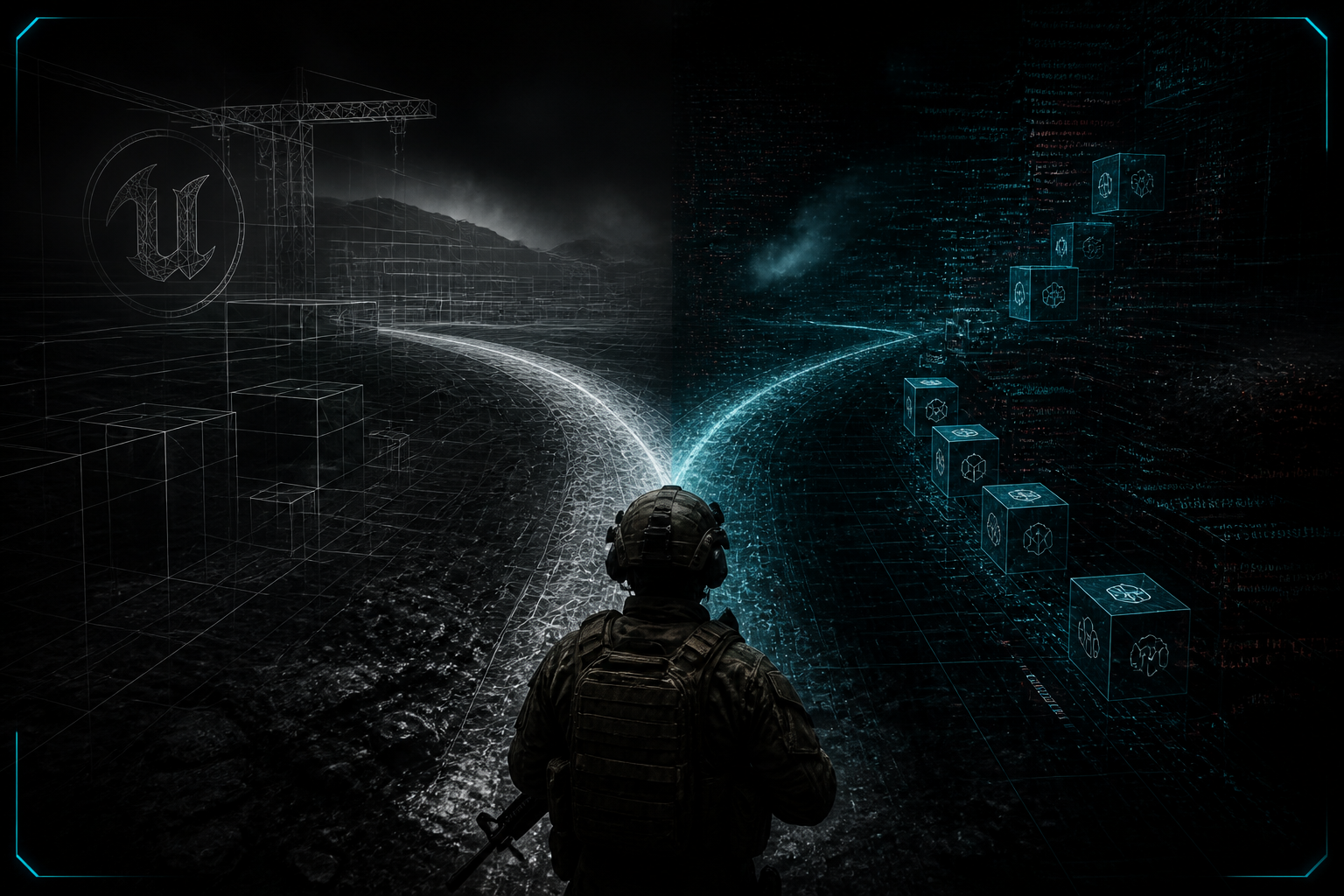
There is a version of this story that sounds like failure: we spent months inside Unreal Engine, then walked away. That is not what happened. We took two steps back so we could take a stronger step forward - back to the engineless game we are building piece by piece, from zero.
Special Ops is a simulation first. Dual objectives, reverse replay, extraction - those systems do not slot cleanly into a general-purpose engine without fighting it at every layer. Unreal is extraordinary. For many teams it is the correct default. For us, the friction showed up in the places that matter most: authoritative netcode, deterministic round flow, and a renderer we could push as hard as the competitive mode demands.
Why we tried Unreal
The pitch is seductive. World-class tooling, a massive talent pool, and a path to polished content without reinventing physics, animation, or editor workflows. We wanted to know whether that trade - convenience over control - was worth it for a 128-tick tactical shooter with rules no off-the-shelf template understands.
We built prototypes. We imported blockouts. We tested UI, networking assumptions, and how fast we could iterate on a 5v5 round loop. Some of it worked. A lot of it did not align with the product we are actually shipping.
What pulled us back
Every time we solved a problem inside Unreal, we inherited a dependency we did not own. The simulation needed to rewind. The server needed to be the single source of truth for shots, movement, and round state. Our level pipeline was already custom - authored in software we wrote for this game, exported straight into a renderer we also wrote for this game.
Reverting was not nostalgia. It was alignment. The engineless stack is slower to stand up and harder to explain in a pitch deck. It is also the only stack where every millisecond, every hitbox, and every frame of reverse replay belongs to us.
Progressive improvement
Two steps back, one step forward is how we build now. Try boldly. Measure honestly. Keep what compounds and cut what does not. Unreal taught us where our bottlenecks really are. Coming home taught us we already had the right foundation - OpenGL first, then Vulkan, custom tools, Ultralight UI, and a map pipeline that does not depend on anyone else's release schedule.
We are not anti-engine. We are pro-ownership. Special Ops will ship as the simulation we designed, on the code we wrote, at the performance level our players deserve. That was always the objective.